



A toddler who is screaming on the floor is not being difficult. She is overwhelmed by a feeling that she cannot yet put into words. One of the most useful things a parent can do is supply the words, again and again, in a calm voice. Sesame Workshop, the nonprofit behind Sesame Street, offers free resources for families about emotions, using familiar characters who talk about feeling frustrated, sad, or excited. You can browse them at sesameworkshop.org. Here is a simple way to use a feelings chart at home, inspired by that approach.
Start with four feelings
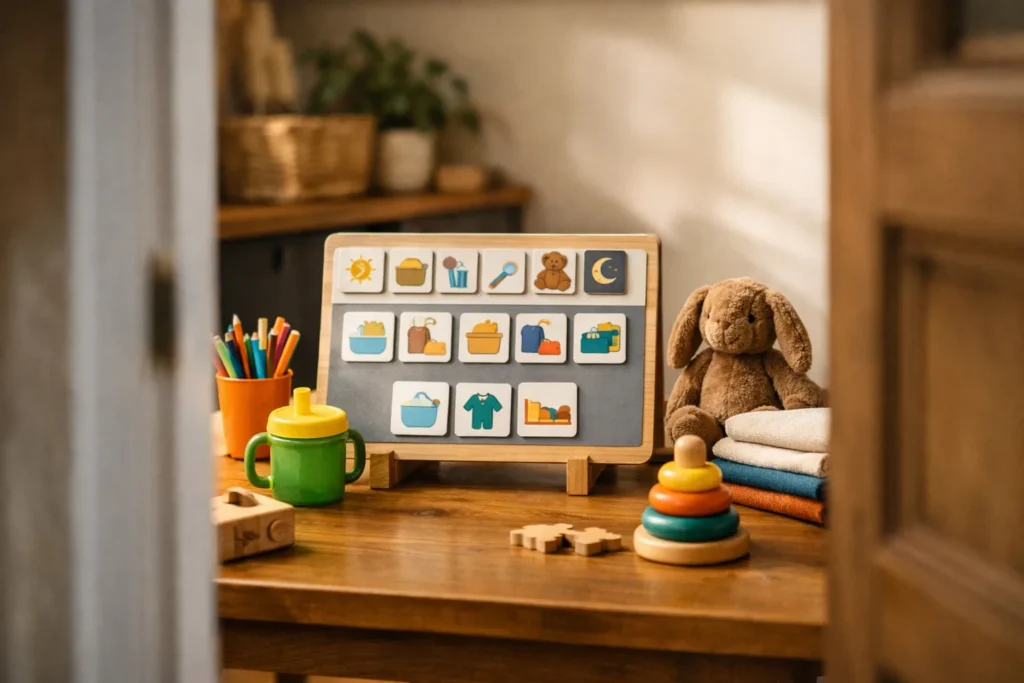
You do not need a chart with twenty faces. Four basic feelings are enough for a toddler: happy, sad, mad, and scared. Draw a simple face for each, or print a few from the free resources, and post them at your child’s height on the fridge or a wall. Point to the one that matches when you see it in action, and say the word aloud.
| Feeling | What it looks like | Phrase to try | Calm-down idea |
|---|---|---|---|
| Happy | Smiling, bouncing, laughing, clapping | “You look happy! Your whole body is dancing.” | Share the joy with a hug or a silly dance |
| Sad | Tears, a droopy face, clinging, a quiet voice | “You feel sad. I am here with you.” | A cuddle, a soft blanket, or a favorite book |
| Mad | Stomping, yelling, throwing, a tight face | “You are mad. It is okay to be mad, but we do not hit.” | Stomp feet, squeeze a pillow, or blow slow “birthday candle” breaths |
| Scared | Hiding, freezing, crying, grabbing your leg | “That was loud. You felt scared. You are safe.” | A close hug, a flashlight, or holding a stuffed animal |
Use short, simple phrases
Toddlers do best with a few words. Say the feeling, say what you see, and offer comfort. “You are sad. You miss Daddy. I am here.” Avoid long explanations, because her brain is flooded and cannot take them in. Once she has calmed down, you can talk a little more about what happened.
Try calm-down ideas
- Belly breaths. Put a stuffed animal on your child’s tummy and watch it go up and down as you both breathe in slowly.
- A cozy corner. A small space with pillows and books gives a place to go when things feel like too much. It is not a punishment spot.
- Movement. Stomping, jumping, or pushing against the wall can help release big energy.
- A sensory break. A cup of water, a cool washcloth, or a quiet song can reset the mood.
Play with puppets
Toddlers often find it easier to talk about feelings through a puppet or a stuffed animal. Let the puppet say, “I am feeling mad because my block fell down,” and ask your child what the puppet could do. Take turns, and let her be the one who comforts. Play moments teach more than lectures in the middle of a meltdown.
Keep expectations realistic
It will take many months before your toddler names her own feelings, and even adults struggle with it at times. Keep naming them anyway, and let her see you doing it too: “I am feeling frustrated, so I am going to take a deep breath.” If you are worried about your child’s emotions or behavior, talk with your pediatrician, who can offer guidance specific to your child.