




Parents often ask, “When should I start?” The honest answer from pediatric sources is that there is no single age. The Mayo Clinic’s patient pages describe potty training readiness in terms of signs rather than birthdays, and the American Academy of Pediatrics says much the same. Many children show interest sometime between about 18 months and 3 years, but a child who is ready at 2 is not ahead of one who is ready at 3. This is general information; every child differs.
Physical signs
- A dry diaper for longer stretches. Staying dry for two hours or more, or waking from a nap dry, suggests bladder control is developing.
- Predictable bowel movements. If they come at about the same time each day, it is easier to plan bathroom trips.
- Walking steadily. A child needs to get to the toilet, sit, and get up again.
- Pulling clothes up and down. Even partial skill helps.
Behavior and language signs
- Showing interest. Following you to the bathroom, asking questions, or wanting to flush.
- Imitating. Copying adults or older siblings, or sitting a doll on the toilet.
- Simple words. Saying “pee,” “poop,” or “potty,” or pointing and making a face.
- Dislike of a dirty diaper. Asking to be changed or tugging at the diaper.
- Following simple directions. “Go get your shoes” is a good test.
Most children show several of these, not all of them. If you see a few, you can try a low-key start. If you see almost none, you can wait.
A quick way to check at home
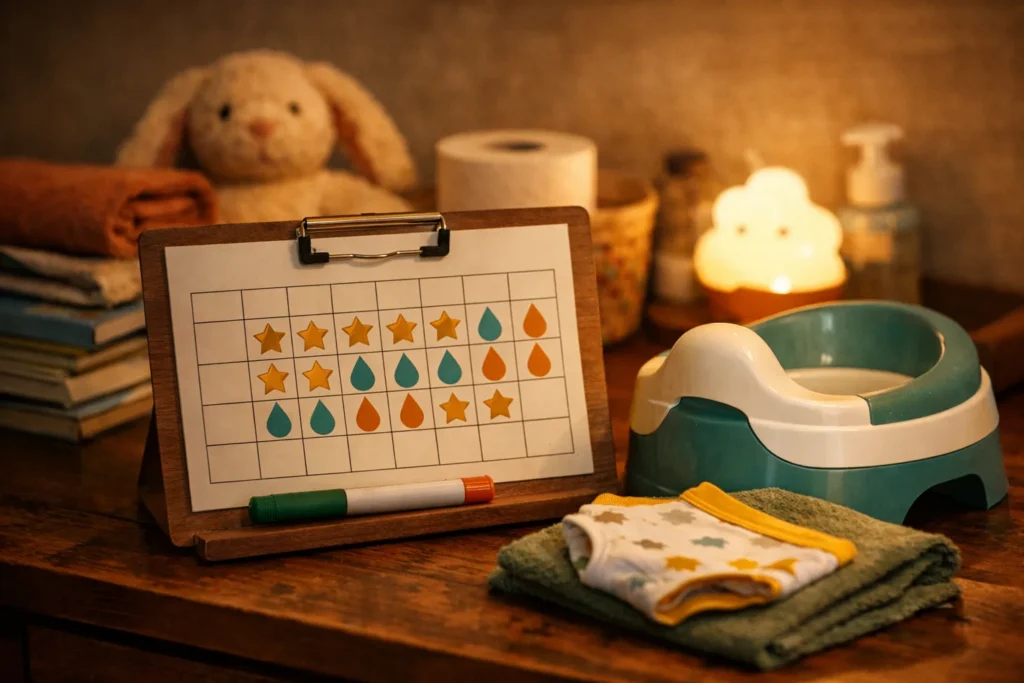
For about a week, jot down when your child wets or soils a diaper. A short note on the fridge is enough: time, wet or dry, and any bowel movement. If diapers are often dry after a nap, or bowel movements show up at predictable times, the pattern shows up quickly. You can also try a few low-pressure experiments. Ask your child to sit on the potty for a minute at a time with clothes on, or let a favorite doll take a turn. Watch the reaction. Curiosity and cooperation are good signs, while crying, hiding, or refusing means it is better to pause and try again later.
Talk with other caregivers too. A grandparent, a babysitter, or a child care teacher may notice signs that you miss at home, such as a toddler who goes to a corner to poop or tells someone that a diaper is wet. Agree on the same simple words so your child hears one clear message.
When it makes sense to wait
Training tends to go better when the household is calm. It is reasonable to pause during a move, a new baby, a change in child care, travel, or an illness, since a child under stress may not make progress and could regress. Starting when a child is clearly resistant often takes longer than waiting a few weeks. There is nothing wrong with a child who is not interested yet.
What readiness does not mean
Being ready does not mean being dry at once. Expect accidents for weeks or months, and expect nighttime dryness to come later than daytime. Children are not ready on a schedule set by day care, grandparents, or a calendar.
When to ask your pediatrician
Talk with your pediatrician if your child is in pain when pooping, is constipated, withholds stools, has frequent urinary accidents after being dry for a long time, or shows signs of fear around the toilet. A child who is past 4 and still shows no interest may also benefit from a conversation. Patient pages at mayoclinic.org and the AAP’s HealthyChildren.org are good starting points for background reading. For the next step, see our guide on play and activities for ideas on keeping a toddler occupied while you wait.