


Toddlers live in the moment, but they also love knowing what happens next. Predictable routines help them feel safe, and the nonprofit ZERO TO THREE often points out that consistent daily rhythms support young children’s sense of security. A visual routine chart takes that idea one step further by giving your toddler pictures she can point to, instead of only hearing grown-up words.
What a routine chart is
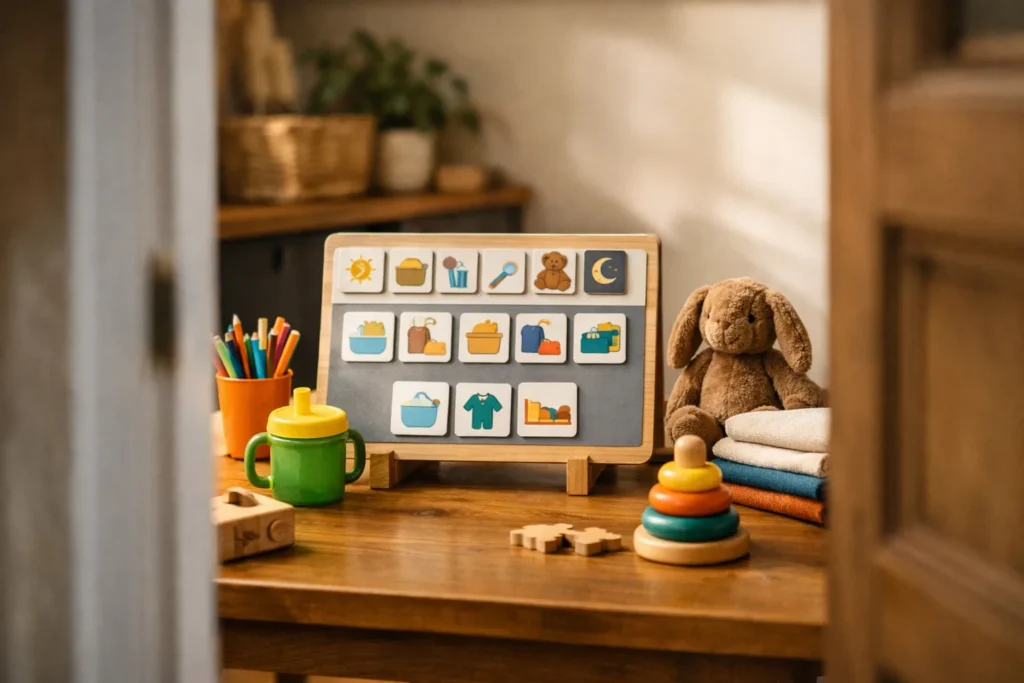
A routine chart is a simple display, such as a strip of paper on the wall at your child’s eye level, with a handful of pictures in the order the day usually unfolds. It is not a schedule to the minute and it is not a behavior chart with rewards or punishments. It is a way to show, “First we do this, then we do that.”
A starter template
| Time of day | Activity | Picture cue | Parent note |
|---|---|---|---|
| Morning | Wake up and get dressed | A sun and a shirt | Offer two outfit choices to give a sense of control |
| Breakfast | Eat together | A bowl and a spoon | Sit at the table with your child, even if you are not eating |
| Late morning | Play or go outside | A ball or a pair of boots | Give a five-minute warning before leaving |
| Midday | Lunch, then nap | A plate and a moon | Keep the pre-nap steps the same each day |
| Afternoon | Snack and quiet play | An apple and a book | Check in on feelings with a short chat |
| Evening | Dinner, bath, books, bed | A fork, a tub, a book, a bed | Dim the lights and slow your voice as bedtime nears |
How to make one
- Pick four to six moments. Choose the parts of the day that cause the most friction or are the most important, such as waking up, meals, nap, and bedtime.
- Use clear pictures. Photos of your own child doing each activity work well, or you can use simple drawings or pictures cut from magazines.
- Attach them in order. Use a strip of paper, a piece of poster board, or a small corkboard. Hook-and-loop dots let you move a card to a “done” pocket.
- Place it low. Your child should be able to see and touch the pictures.
Introducing it without pressure
Start with a single part of the day, such as the bedtime routine, and add more once it feels familiar. Look at the chart together, point to each picture, and say what happens next. Let your toddler move the pictures if she wants to. The point is to be a guide, not a boss, so avoid saying “You did not follow the chart.” If a day goes off track, that is fine. Routines support children when they are flexible enough to bend for sick days, trips, or surprises.
What to expect
A chart will not magically end every protest, and a one-year-old may not understand it at all. Many two- and three-year-olds, though, like having something to point at. It can make transitions smoother, because the chart is the one saying what is next. Over time, your child may start reminding you of the order, which is a sweet sign that the rhythm of the day is sinking in.
Every family’s day looks different, and no chart is perfect. If you have concerns about your child’s behavior or development, ask your pediatrician for advice that fits your child.