


If your living room looks like a toy store after a storm, you are not alone. A big pile of toys does not necessarily make for more play. Many parents notice that their toddler flits from one thing to the next, or ignores everything and goes for the remote control. A rotation system, in which only a handful of toys are out at a time, is one way to calm the chaos. The idea echoes the approach of Maria Montessori, the Italian educator whose life and work are summarized on Wikipedia, and which the American Montessori Society describes in its materials for families: a prepared, orderly space with a few thoughtful choices, set at a child’s level.
How the four-week rotation works
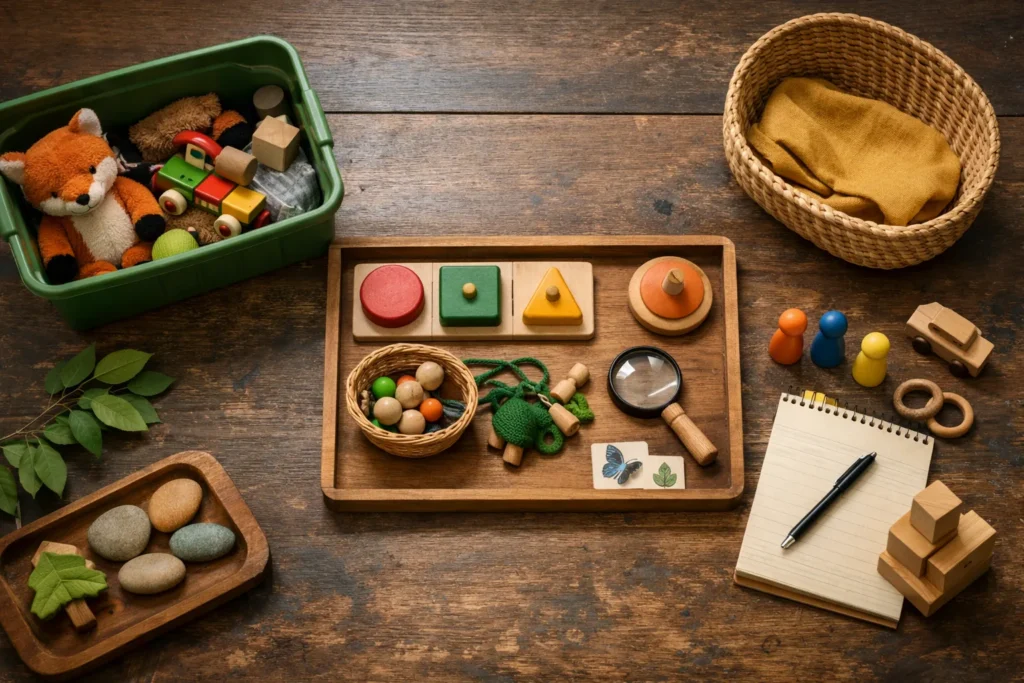
Gather all of your toddler’s toys and sort them into four rough groups. Mix types within each group so every week includes something for movement, something for fine motor skills, and something for pretend play. Put three groups into bins out of sight, and set out a single group on a low shelf. At the end of each week, swap the shelf for a different bin.
A good starting point is six to eight toys out at a time. If that feels like too few, add a couple, but be careful not to go back to the overflowing shelf. Books can be kept on a separate display, since toddlers tend to enjoy having a few in reach at all times.
| Week | Toys out | Skill practiced | What we noticed |
|---|---|---|---|
| 1 | Wooden blocks, a ball, a shape sorter, two board books | Stacking, hand-eye coordination | Long stretches of block building, then knocking over towers with a big grin |
| 2 | Stuffed animals, a toy tea set, a baby doll with a blanket | Pretend play, caring for others | Lots of talking, serving tea to everyone, and tucking dolls in for naps |
| 3 | Chunky puzzles, a stacking cup set, a basket of scarves | Problem solving, matching | Frustration at first, then a proud finish when we sat nearby without helping |
| 4 | Push toy, a drum, soft balls, a tunnel made of couch cushions | Gross motor, rhythm | High energy and a lot of noise, best earlier in the day |
What to put out, and what to put away
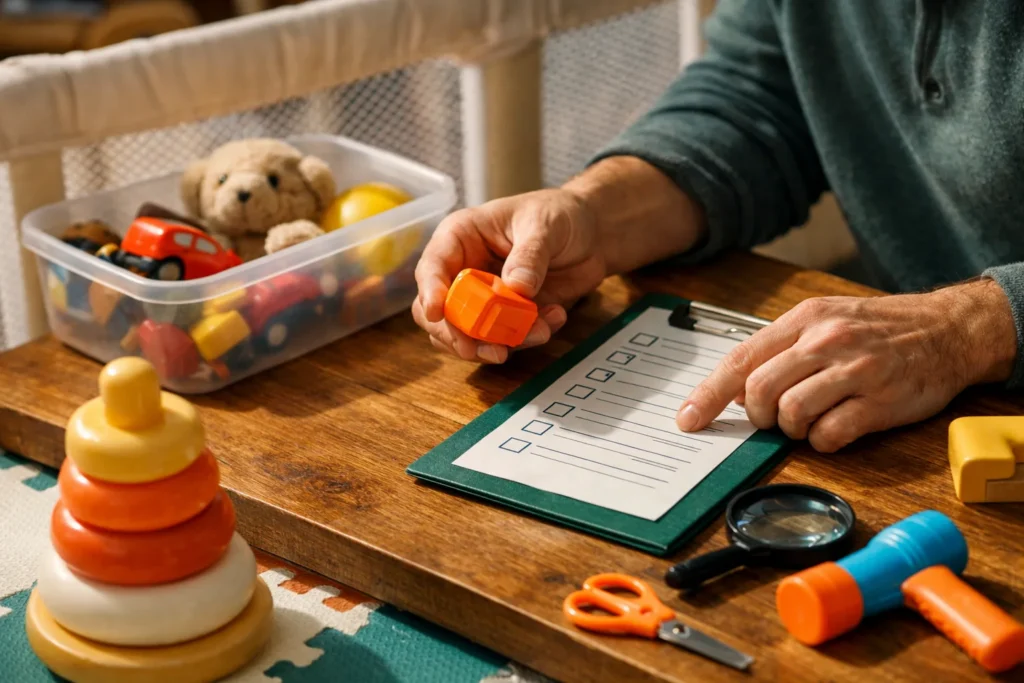
Choose toys that can be used in several ways. Open-ended items such as blocks, cups, scarves, and balls tend to hold a toddler’s interest longer than toys that do one thing. Hold back the loud and flashy ones, or rotate them out first if your child seems overstimulated. Toys that are broken, missing pieces, or no longer safe should be removed, not stored. Follow the age label on every toy, and keep small parts away from children under three.
Watch and learn
The real payoff of a rotation is what you learn by watching. Over a few weeks, you will see which toys your toddler returns to again and again and which sit untouched. Jot down a quick note each week, like the “What we noticed” column above. You might find that your child loves anything with wheels, or that she needs a quiet, solo activity right after lunch. Those observations can guide what you buy, borrow, or give away, and they help you spot new skills as they show up.
Making the switch smooth
- Do the swap while your child is asleep or out. A fresh shelf feels like a little surprise, and no one has to argue about which toy has disappeared.
- Do not be rigid. If your toddler asks for a toy in a bin, it is fine to bring it out. The point is less clutter, not strict rules.
- Keep the shelf low and tidy. Arrange items in baskets or on trays so your toddler can see what is there.
- Let your child help. Even a one-year-old can put a block in a basket, and tidying up becomes part of the game.
When rotation does not fit
Not every family will love this approach, and that is fine. If a certain stuffed animal or blanket is essential for comfort, leave it out. Children going through a big change, such as starting child care or welcoming a sibling, may need the reassurance of a familiar set of toys. The goal is a calmer, more engaging play space, not a perfect system.
If you have concerns about how your child plays or develops, bring them to your pediatrician, who can look at your child’s overall growth and advise you.